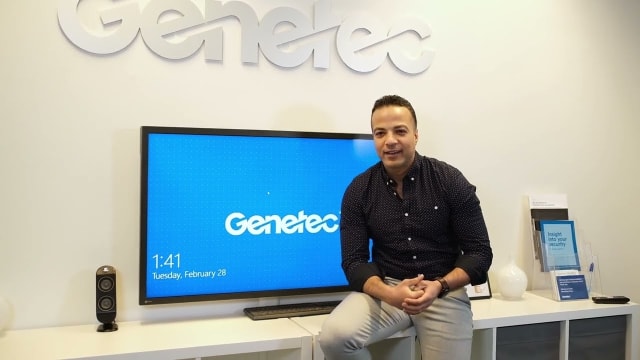
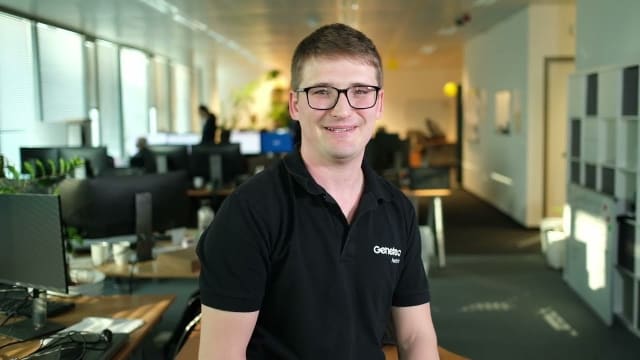
Rafal Dabek, Back End Developer at Genetec
Rafal Dabek von Genetec erzählt im Interview wie er zum Programmieren gekommen ist, was das Spannende an seiner aktuellen Arbeit ist und spricht darüber, was seiner Meinung nach wichtig für Beginner ist. Mehr zum Team von Genetec: https://devjobs.at/team/genetec devjobs.at IT Career Days Playlist: https://www.youtube.com/playlist?list=PLxwoARCP1-pStxUV52y__-iN43N8BMJ2P
Video summary
In 'Rafal Dabek, Back End Developer at Genetec,' Speaker Rafal Dabek traces his path from building a small game at 16 and learning C/C++ to 2.5 years at Genetec, where he develops video-processing pipelines for the Privacy Protector product. He highlights the appeal of backend work—architecting systems and seeing what happens behind the UI—and the challenge of tackling novel problems without ready-made online answers. His takeaways for developers: use C++ and Docker, start by building a project you’re excited about, practice analytical thinking and problem decomposition, and stay current via CppCon and new compiler features.
C++ in the Trenches: Back-End Architecture, Video Pipelines, and Problem-Solving — Insights from “Rafal Dabek, Back End Developer at Genetec”
Why this session stands out
Some developer stories are memorable because they’re refreshingly direct. “Rafal Dabek, Back End Developer at Genetec” delivers exactly that: a crisp account of how a self-started C/C++ path becomes real-world back-end ownership over a video image processing pipeline, and what it actually feels like to build architecture, solve novel problems, and keep your tools sharp.
We at DevJobs.at tuned in to understand how this journey unfolds in practice. What we heard was a human, no-frills narrative: coding a small game at 16, learning C then embracing C++, working for 2.5 years at Genetec on a product called Privacy Protector, and focusing on building “the pipeline for processing the video image.” Along the way, Rafal highlights what he likes about back-end work — seeing “how much stuff is actually going on behind the UI” — and what makes it challenging — problems he hasn’t seen before that are “very hard to find on the internet.” His preferred tools are C++ (and the ecosystem around it) and Docker, and his advice to beginners is straightforward: pick a cool project and do it. To stay up to date, he watches the CppCon YouTube channel and researches the latest compiler versions and features.
That’s the whole arc in a nutshell. The value is in the focus: build, decompose, think, iterate.
The early spark: a small game at 16
Rafal’s starting point is both simple and telling: at around 16, he coded a small game outside school. First in C, then in C++. This is the kind of project-driven onset that often shapes long-term engineering habits. There’s no elaborate curriculum here; there’s a problem you care about and the persistence to make it work.
- First language: C — direct control, memory, performance, the machine’s reality.
- Next step: C++ — today his main and favorite language.
“Just find yourself a very cool project that you want to work on and just do it.”
That one line doubles as a career blueprint. When you pick something you genuinely want to exist, the learning compounds and sticks. Years later, that same bias toward building shows up in his back-end role: a pipeline, not a slide deck; outcomes, not slogans.
2.5 years as a Back End Developer at Genetec: working on Privacy Protector
The session names a clear product: Privacy Protector. Rafal’s main job: create the pipeline for processing the video image. Without venturing beyond what’s stated, this already tells us a lot about the nature of the work:
- Data-centric thinking: frames and image streams must be processed reliably and efficiently.
- Architecture over time: “You also get to experience building the architecture and seeing it develop.” Architecture is a living thing under production constraints.
- Debugging the invisible: “You get to see how much stuff is actually going on behind the UI.” The real action is in pipelines, state transitions, buffers, and latency.
The point is clear: back-end development here isn’t just a service wrapper; it is the beating heart of a system that must deliver predictable behavior under real conditions.
Behind the UI: the invisible complexity
Rafal’s comment about all the work behind the UI encapsulates what makes back-end engineering compelling. A click on the surface can involve a chain of validation, queuing, scheduling, processing, and persistence that users never see but always feel.
- UI is the endpoint; the back end is the engine. The perceived simplicity at the top masks nontrivial complexity underneath.
- In video pipelines specifically, order, buffering, and quality-versus-latency trade-offs dominate the conversation.
- “Seeing it develop” means accepting architectural intermediate states — multiple versions, uneven module maturity — while maintaining a system that keeps running.
This is the joy of the craft: shaping system behavior at its core.
The hard problems: when there’s no ready-made answer online
A defining line in the session is that daily challenges often involve problems he’s “never seen before” and that are “very hard to find on the internet.” That’s the signature of professional problem-solving. The job is not to paste an answer; it’s to refine a question, run experiments, and reason carefully about trade-offs.
Problems that “are very hard to find on the internet” force you to genuinely think.
Back-end work — especially in data and media pipelines — constantly encounters ambiguity: protocol edge cases, timing, real-world load, failure modes. This is where analytical thinking and decomposition turn uncertainty into forward motion.
Tooling that fits the job: C++, its ecosystem, and Docker
Rafal’s favorites line up naturally with his responsibilities:
- C++ as the primary language: direct control, performance, deterministic resource management — attributes you want when moving and transforming video data.
- Tools around C++: build systems, package managers, linters, profilers — the session doesn’t enumerate them, but the emphasis on the ecosystem is telling.
- Docker: he finds containerization — “in this case virtualizing” — very cool. Containers promote reproducibility and isolation, essential when the correctness of a pipeline depends on consistent environments.
The lesson is straightforward: choose tools that reinforce the constraints you live with. If your system is time-, throughput-, and resource-sensitive, a C++ plus containerized stack makes solid sense.
Staying current: CppCon and compiler features
Rafal keeps his edge by watching the CppCon YouTube channel — a venue where “the newest improvements, ideas concerning C++ are introduced” — and by researching “the newest versions and features of C++ compilers.” That’s a pragmatic approach: follow the language evolution where it’s distilled by practitioners, and pay attention to compiler releases because they change real-world outcomes.
- CppCon surfaces new idioms, features, and practices.
- Compiler versions and features impact optimization, diagnostics, code size, and safety.
It’s learning aimed at tangible results.
From side project to production system: the throughline
There’s no rupture between a small game at 16 and a production video pipeline years later. There’s a line: build something you care about, learn by doing, and grow the scope of responsibility.
- Project-driven start: learn C, move to C++, assemble small systems.
- Production mindset: own architecture, stability, and performance.
- Continuous learning: watch talks, read release notes, try compiler features.
This combination generates both enjoyment (“seeing how much is going on behind the UI”) and professional maturity (solving problems you won’t find pre-answered online).
The back-end skill set: analysis and decomposition
Rafal calls out two core skills we see recurring across reliable teams:
- Analytical thinking
- Splitting a problem into smaller chunks and solving those chunks
Decomposition without analysis is scatter; analysis without decomposition is paralysis. In pipelines in particular, it’s the fusion of both: turn a flowing workload into stages with crisp responsibilities, define interfaces, isolate failure domains, and then implement each segment well.
Actionable takeaways we’re carrying forward
Within the bounds of the session, here’s what we’re putting into practice:
- Project-first learning: start with something you genuinely want to exist. The energy comes from purpose.
- Use C++ deliberately: when latency, throughput, or resource control matter, it’s a strong fit — and its ecosystem is deep.
- Default to containers: Docker enforces reproducibility and makes debugging less environment-dependent.
- Treat architecture as an evolving system: “seeing it develop” requires observability, iteration, and patience.
- Don’t just hunt for answers — refine the question: when the internet doesn’t help, hypothesis-driven exploration does.
- Stay close to the C++ community: CppCon talks and compiler release notes are direct lines to practical improvement.
- Decompose to progress: break work into digestible, testable parts — especially in pipelines.
Thinking in video pipelines: general patterns for context
The session does not dig into privacy or product specifics, and we won’t speculate. But the phrase “pipeline for processing the video image” implies a family of concerns common to such systems. Treat these as general principles rather than claims about any particular implementation:
- Staging over monolith: ingest, pre-process, transform, possibly annotate/anonymize, and output — clear stage boundaries make testing and iteration easier.
- Time and memory: video is time-sensitive; buffering strategy and latency budgets are first-class design choices.
- Isolate failure domains: a stage that fails should degrade gracefully rather than collapsing the whole pipeline.
- Reproducibility: containerized environments reduce “works on my machine” drift and accelerate root-cause analysis.
- Make the invisible visible: metrics, logs, and tracing bring the back end’s hidden work to light — critical when solving problems that aren’t documented elsewhere.
These patterns harmonize with the skills Rafal highlights: analytical thinking and problem decomposition.
Learning like Rafal: a compact, practical plan
If you want to internalize the mindset described in the session, a pragmatic plan might look like this — inspired by the same principles:
- Weeks 1–2: Define a small “cool” project (e.g., a simple image/video tool). Optimize for genuine interest.
- Weeks 2–3: Set up a C++ skeleton with your chosen tooling (build, tests, lint). Plan work in small steps.
- Weeks 3–4: Containerize with Docker so your dev and runtime environments are reproducible.
- Ongoing: Watch CppCon talks and try one or two features from recent compiler versions.
- Every iteration: Decompose tasks, add measurement points, and document observations.
The constant throughline: build, observe, improve — and keep learning.
Motivation: the satisfaction of architecture and the “invisible”
Rafal underscores the satisfaction of “building the architecture and seeing it develop.” That’s a genuine motivator on back-end teams. Progress isn’t always visible in screenshots, but you feel it when a pipeline stabilizes, latency drops, or logs speak more clearly. The early joy of making a small game morphs into the professional satisfaction of making a robust system behave well.
Mental models for the day-to-day
Based on the session, we advocate three mental models for back-end practice:
- Pipeline thinking: data flows — design the flow. Name stages, queues, buffers, and measurement points.
- Errors as information: when there’s no online answer, you’re in learning territory — measure, narrow, hypothesize.
- Toolchain fluency: language, compiler, container — the better you understand them, the more reliable your system becomes.
These models reinforce the very skills the session calls out.
A word to beginners
The session’s advice is plain and potent:
“Just get into it. … find yourself a very cool project … and just do it.”
Don’t wait for perfect clarity. Build something you want to exist. Then keep going — one chunk at a time.
In practical terms:
- Pick a project you’re excited about — not what’s trendy this week.
- Start small but think production: logging, tests, containers.
- Reflect regularly: what worked, where was friction, and what chunk comes next?
Closing: our takeaways from “Rafal Dabek, Back End Developer at Genetec”
This session is a clear reminder of what solid back-end work is made of:
- Joy in the work behind the UI — where the true complexity lives.
- Architecture as a living system — plan, build, observe, refine.
- C++ as a deliberate choice for demanding, performance-sensitive tasks.
- Docker as a practical path to stability and reproducibility.
- Learning as a habit — CppCon and compiler evolution.
- Problem-solving as thinking work — analytical, decomposed, exploratory.
In “Rafal Dabek, Back End Developer at Genetec,” we heard a grounded developer story: an early start with C/C++, now building a production video image processing pipeline in C++, facing novel problems daily, and staying current through community and compilers. That mix — curiosity, ownership, craft — is exactly what makes back-end teams strong.
More tech lead stories
Florian Matusek, Product Group Director at Genetec
Product Group Director bei Genetec Florian Matusek erzählt im Interview über die Aufgaben des Teams und woher der Spitzname "Wrecking Crew" für die Abteilung kommt.Stephan Sutor, Product Group Director at Genetec
Product Group Director bei Genetec Stephan Sutor spricht im Interview über Domain Driven Design und wie dieses Prinzip im Team angewandt wird.

More dev stories
Moemen Saad, Senior Software Developer at Genetec
Moemen Saad von Genetec spricht im Interview über seine Anfänge mit C#, was ihm an seiner aktuellen Arbeit am besten gefällt und gibt Tipps für Neueinsteiger.Ilia Gutu, Mobile Developer at Genetec
Ilia Gutu von Genetec erzählt im Interview über seinen Werdegang, angefangen mit Delphi, über Umwege im Embedded Development bis hin zu seiner aktuellen Arbeit als Mobile Developer und gibt Tipps, wie man am Besten up to date bleibt.Spandana Kanadam Ravindranath, Computer Vision Developer at Genetec
Spandana Kanadam Ravindranath von Genetec redet im Interview über ihre ersten Berührungspunkte mit dem Programmieren, was ihre aktuelle Arbeit als Computer Vision Developer umfasst und gibt Tipps für Leute, die ebenfalls in diesem Berufsfeld starten möchten.